

What?
These two feature asks are really only useful as a package for this use case.
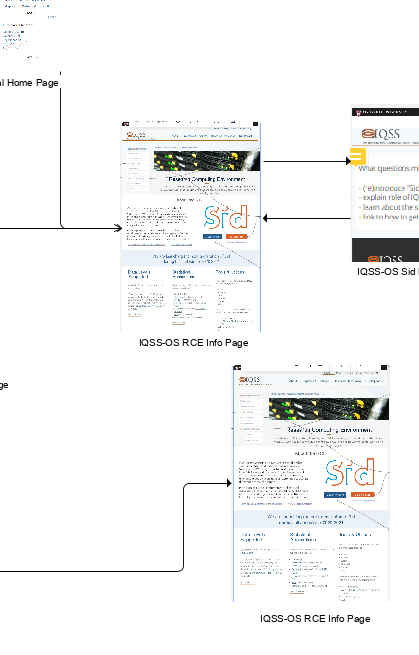
In this picture you see two identical visual representations of a web page: “IQSS-OS RCE Info Page”. These are in-fact the same item shown twice on the same page (that’s the transclusion). In this example, the two “copies” are on the same page, but it would be just as important to support this across maps!
These pictures have an associated description and list of comments (discussion) associated with them. Any changes made to any property of one will be made in the other. (that’s the inclusion of the information in the objects themselves)
The attached picture is from another tool. It’s intended to show transclusion within a single Miro Frame.
Context:
- We are deep into a UX design. We are collaborating with Miro.
- We finished one proposed flow in a frame and want to do a second version and then a third.
- In the second frame, (the second version of the flow) some of the depicted pages (represented as pictures) will remain the same.
- The way we depict those pages that remain the same today is that we make a copy of that original frame with all of it’s depicted pages and start reworking things.
The Problem:
- In the first flow we put a lot of work into discussions of particular pages, their content, why we want them to look a certain way, etc.
- All of that is lost as soon as we make a copy. All of it.
The current work-around:
- Go back to the original copy of the image and re-read the associated notes and comments. Not ideal. Not everyone goes back and does the due diligence and the conversation can get off track over time.
- Link back to the first version from each follow-on copy of that image.
How I’ve seen this done succesfully.
In another tool I’ve used:
- Each object on the board has a set of included properties that include a description, a label, and comments.
- The transcluded copies all act as if they are the original so that each displays the comments and has the same label and any changes made to any of those items in the first are made to all.
See also:
